

PROFESSIONAL LICENSE DISCLOSURE
OUT-OF-STATE STUDENT – LICENSURE DISCLOSURE
The Mildred Elley Practical Nursing and Massage Therapy programs require students to complete program requirements in New York State. The following chart shows the licensure programs offered by the campus and indicates the state in which the student is eligible to apply for licensure after graduation requirements are fulfilled.
Similarly, suppose a student is enrolled in a licensure-based program and moves to a different state. In that case, the institution does not imply or guarantee that the student will be eligible to be licensed in their new state of residence.
Please note that due to New York State authorization and licensure requirements, our licensure programs are not available to students residing outside New York state. At this time, these programs cannot be completed online by out-of-state residents
Information regarding licensure in New York State for Massage Therapy can be found here: https://www.op.nysed.gov/massage-therapy. Information regarding licensure in New York State for Licensed Practical Nurses can be found here: https://www.op.nysed.gov/licensed-practical-nurses.
| Campus | Licensure Program* | State Where Student Can Apply for Licensure** |
| Albany | Practical Nursing | New York |
| Albany | Massage Therapy | New York |
| New York City | Practical Nursing | New York |
| New York City | Massage Therapy | New York |
| *Upon successful completion of program graduation requirements. | ||
| ** Licensure requires successful completion of a licensing exam. Mildred Elley does not guarantee licensure. | ||
Complaint Resolution for Distance Education
Students taking online classes offered by Mildred Elley, including those residing outside of New York State, should attempt to resolve any issues or complaints with the institution first. The first course of action includes notifying the parties or the administration involved. Concerns must be submitted through the process outlined in the Institutional Grievance and Decision Appeal Procedures on the institution’s disclosures page, located here.
The institution’s complaint procedures, which cover any institutional complaint, including grade disputes, as well as complaints concerning bias and discrimination, are also available in the institution’s academic catalogs.
National Council for State Authorization Reciprocity Agreements (NC-SARA) Complaints
Student complaints not related to grades or student code of conduct, which involve distance learning education under the terms and conditions of NC-SARA. Only those complaints resulting from distance education courses, activities, and operations provided by SARA-participating institutions to students in other SARA states come under the coverage of SARA. A student may appeal the institution decision to the SARA State Portal Entity in New York State within two years of the incident about which the complaint is made.
Complaints which have not been satisfactorily reconciled by the institution can be submitted to the following agencies:
- New York State Education Department (NYSED) (complaint procedures (https://www.nysed.gov/college-university-evaluation/sara-student-complaint-process).
Additional general information about the student complaint process can be found at NC-SARA complaint procedures ( https://www.nc-sara.org/sara-student-complaints-0)
NC-SARA Responsibilities for resolving complaints[1]
a. Institutions operating under SARA policies shall provide their and SARA’s complaint resolution policies and procedures to all students taking courses under SARA policies on the institution’s website and in the institution’s catalog or equivalent information provided either in print or electronically to students when they enroll.
b. Initial responsibility for the investigation and resolution of complaints resides with the institution against which the complaint is made. Further consideration and resolution, if necessary, is the responsibility of the SARA State Portal Entity and other responsible agencies of the institution’s home state (see Sections 2.5 and 4.5).
c. The SARA State Portal Entity is responsible for conducting the investigation and resolution of complaints that are not resolved at the institutional level. The SARA State Portal Entity may enlist the assistance of other responsible entities in the state in carrying out the work of complaint resolution.
Explanatory Notes: N1 – If a home state does not currently handle investigations and consumer protection for all of its distance education providers, will the home state need to start doing that? Yes. SARA centralizes primary responsibility for problem-solving in the home state, therefore the home state needs to be prepared to handle a larger volume of communication and issues for its domiciled, SARA-participating providers, even as its work with providers based in other states decreases. See federal rules for possible additional requirements.
d. The SARA State Portal Entity is ultimately responsible for ensuring that a valid complaint results in proper redress.
The SARA State Portal Entity may delegate responsibility to investigate and resolve such complaints to another government agency (e.g., a board of regents) or to a special body created to handle SARA complaints for a group of institutions but must have and retain the function of hearing any appeals from decisions made by other agencies. The SARA State Portal Entity cannot merely have advisory powers; it must have the formal authority to provide final resolution of SARA-related complaints and ultimately to remove any Institution, public or independent, from the state’s list of SARA-eligible providers if that institution fails to abide by SARA policies.
e. No SARA member state gives up its ability to investigate misrepresentation, fraud, or other illegal activity by institutions based in other states, including SARA-participating institutions.
f. SARA member states retain the ability to use any of their general-purpose criminal or consumer protection laws against an institution that violates those laws. State oversight of distance education delivered by a SARA-participating institution to students in any SARA member state is centralized by SARA policy in the institution’s home state.
g. Mandatory arbitration agreements do not pertain to SARA policy, and, as such, SARA participating institutions are not permitted to enforce these on students enrolled under SARA provisions. Disputes between students and institutions on SARA-related matters are to be resolved by the institution’s SARA State Portal Entity following the SARA complaint process outlined in Section 4.5 or through other means. Institutions that utilize mandatory arbitration agreements for the resolution of non-SARA complaints or disputes shall provide a disclosure that such agreements must not be applied toward a complaint or dispute that falls within the scope of the SARA Policy Manual.
NC-SARA Process for resolving complaints[1]
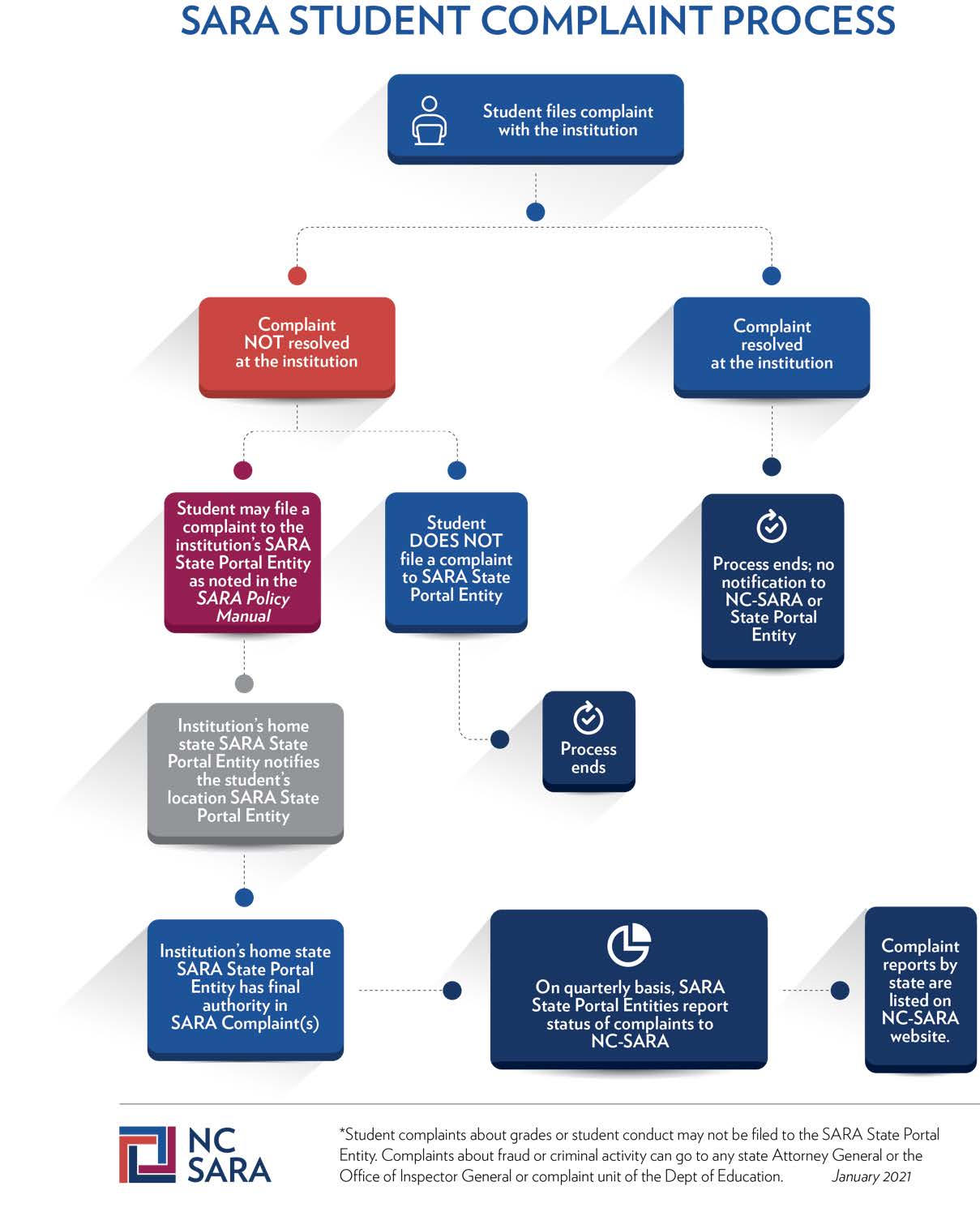
a. Complaints against an institution operating under SARA policies go first through the institution’s own procedures for resolution of grievances. Allegations of criminal offenses or alleged violations of a state’s general-purpose laws may be made directly to the relevant state agencies.
b. Complaints regarding student grades or student conduct violations are governed entirely by institutional policy and the laws of the SARA institution’s home state.
c. If the complainant is not satisfied with the outcome of the institution’s complaint process, the resolution of the complaint (except for complaints about grades or student conduct violations) may be appealed, within two years of the incident about which the complaint is made, to the SARA State Portal Entity of the home state of the institution or to the SARA State Portal Entity of the state in which the student is located.
The SARA State Portal Entity that receives the appeal shall notify the SARA State Portal Entity of the institution’s home state and provide to the student the contact information of the SARA State Portal Entity of the institution’s home state. The resolution of the complaint appeal by the institution’s home state SARA State Portal Entity, through its SARA complaint resolution process, will be final, except for complaints that fall under the provision “g” below.
d. The SARA State Portal Entity of the institution’s home state shall communicate its final resolution of a complaint appeal to the student and to the SARA State Portal Entity of the state where the student was located at the time of the incident leading to the complaint, if known.
e. While final resolution of complaints (for purposes of adjudication of the complaint and enforcement of any resultant remedies or redress) resides in certain cases with institutions (complaints about grades or student conduct violations), or more generally with the relevant institution’s home state SARA State Portal Entity (all other complaints), the regional compact(s) administering SARA may consider a disputed complaint as a “case file” if concerns are raised against a SARA member state with regard to whether that state is abiding by SARA policies, as promulgated in the SARA Policy Manual. The regional compact may review such institutional concerns in determining whether a state under its SARA purview is abiding by SARA policies. Similarly, a complaint “case file” may also be reviewed by NC-SARA in considering whether a regional compact is ensuring that its SARA member states are abiding by the SARA policies required for their membership in SARA.
f. SARA State Portal Entities shall report quarterly to NC-SARA the number and disposition of appealed complaints that are not resolved at the institutional level. NC-SARA shall make that information publicly available on its website. Such data will create transparency and can be used in determining whether a regional compact is ensuring that its SARA member states and those states’ institutions are abiding by the policies required for state membership and institutional participation in SARA.
g. Nothing in the SARA Policy Manual precludes a state from using its laws of general application to pursue action against an institution that violates those laws.
INSTITUTIONAL GRIEVANCE AND DECISION APPEAL PROCEDURES
The institutional grievance and decision appeal procedures provide for the prompt and equitable resolution of a complaint from an individual either currently or formerly associated with Mildred-Elley. Any person who files a complaint is assured that the institution will not take action either overt or covert, against that person for filing said complaint and that provisions for the final determination of each formal complaint will be made by an impartial party who is not directly involved in the alleged grievance
The grievance and appeal procedure applies in a variety of situations. These situations include appeals of grades, transfer credit decisions, and other situations where the complaining party believes they might have been treated unfairly and/or in violation of the institutional policies, or where special consideration might be warranted due to extenuating circumstances.
The institution and its officials will make the best effort to resolve grievances and appeals of institutional decisions in an expeditious, equitable and fair manner.
The following grievance procedures have been developed for student use should a problem arise:
- A student with a grievance should attempt to discuss the matter in an informal manner and reach a resolution with the instructor. The next step, should the matter remain unresolved, is to discuss the matter with the student’s advisor (usually, the Department Chair for the program of enrollment). Students whose complaint concerns a matter not specific to a given course will begin the grievance/appeal process at the student’s advisor level.
- If the problem cannot be resolved at the student advisor’s level, the student should then submit the matter to the Dean of Academic Affairs in writing. The letter describing the grievance should contain pertinent facts and be signed by the complainant. The Dean will consider the grievance within fifteen (15) business days from the date it was received and communicate the decision to the complainant in writing within five (5) business days from the date the decision was made.
- The student may appeal the decision of the Dean of Academic Affairs in writing to the Student Appeal Review Committee within ten (10) business days from the date the decision was mailed or communicated to the student. The Student Appeal Review Committee will consider the appeal within fifteen (15) business days from the date it was received and communicate the decision to the complainant in writing within five (5) business days from the date the decision was made. The decision of the Student Appeal Review Committee shall be considered final.
The Student Appeal Review Committee is comprised of three members selected by the Campus President and which may include the Campus President, a Department Chair, from a department other than the student(s) home department, the Director of Academic Support and Advising, a Dean other than the Dean involved in Step 2 and any other member as appointed by the Campus President.
Any student with a grievance that he/she cannot resolve through the college may contact:
- the New York State Education Department, Office of College & University Evaluation; 89 Washington Ave., Room 960 EBA Albany, New York 12234, https://www.nysed.gov/college-university-evaluation/sara-student-complaint-process; or
- Middle States Commission on Higher Education (MSCHE). 1007 North Orange Street, 4th Floor, Wilmington, DE 19801. (267) 284-5011, www.msche.org